Best Hackathon Hosting Platforms for 2026
Compare 10 hackathon hosting platforms for 2026 on registration, judging, team formation and ready-to-build cloud environments, with real event data.
The best hackathon hosting platforms for 2026 are CloudLabs, for hackathons where participants build on real cloud environments; Devpost and HackerEarth, for large public and hiring hackathons; AngelHack and BeMyApp, if you want an agency to run the whole event; TAIKAI, Eventornado and Agorize, for self-run and open-innovation challenges; Heropa, for lab environments alone; and lablab.ai, for sponsoring public AI hackathons.
Most lists compare these platforms on registration, team formation and judging. Every platform here has some version of them. Few lists check where participants build. If your hackathon asks people to deploy on Azure, AWS or Google Cloud, someone has to provision hundreds of environments, keep cloud spend under control and delete everything afterward. We compared all ten on that too. Each entry gives a “best for” line, the main features and one limitation, taken from the vendor’s own pages in October 2026. Below the list you’ll find a comparison table, a 12-week plan for hosting a hackathon online, and what hackathons cost.
1. CloudLabs
Best for: companies whose hackathon participants have to build on Azure, AWS or Google Cloud, from 100-person internal events to programs with more than 1,000 participants
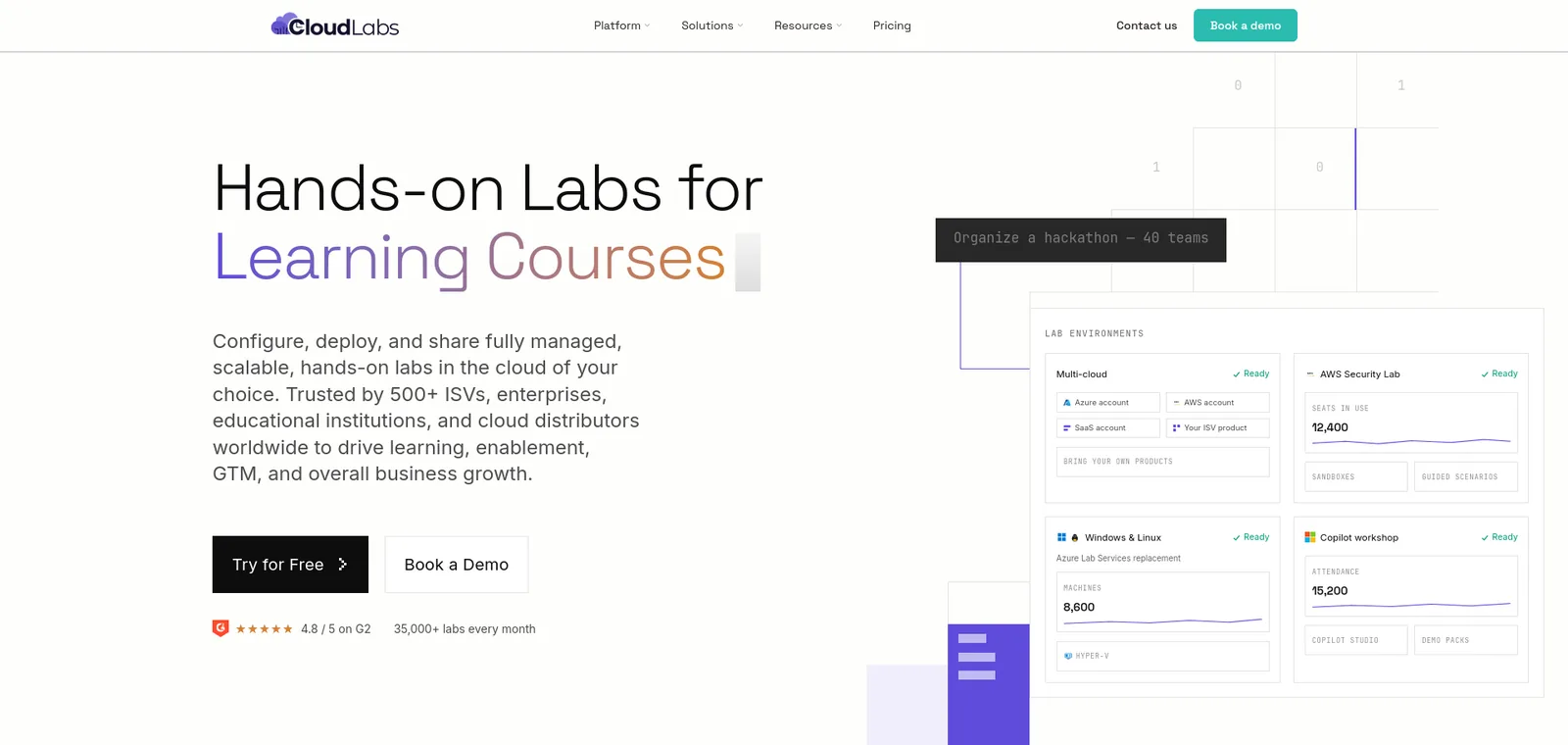
CloudLabs runs the hackathon and the cloud environments participants build in. It handles registration with team formation and automated approvals, sets up an environment for each team and tests it before the event, provides coaches, and runs judging, leaderboards and certificates. It offers two formats: challenge-based hackathons of one to two days with automated validation and scoring, and open innovation hackathons of one week to one month with sandboxes, cloud credits and jury judging.
The case for CloudLabs rests on the events it has run:
- IBM Agentic AI Hackathon 2025: more than 450 participants in 225 teams from 25 countries over 30 days, co-hosted by IBM Consulting and Microsoft. Each participant got a pre-configured environment from day one. CloudLabs tracked Azure spend at the team level and deleted the labs after the event. It was IBM’s third straight year running its hackathon on CloudLabs.
- Capgemini AI Agents Hackathon: more than 1,200 participants on a purpose-built agentic AI lab, with zero environment failures and a satisfaction score of 4.5 out of 5.
- DXC-MS AI Hackathon 2025: more than 150 participants over 20 days, from April 20 to May 10, 2025, on browser-based labs with no software to install.
- EY Olympiad InnovateX Hackathon 2024: more than 100 participants over three days on more than 10 use-case labs (Azure OpenAI, AI Studio, Document Intelligence, Fabric, Power BI). Zero disruptions, 4.42 out of 5 satisfaction.
- Databricks Data + AI Summit: a virtual event with 7,000 attendees. Databricks says CloudLabs secured the cloud VM quota it needed and load-tested the environment a month before the event.
Across all its work, CloudLabs reports more than 5 million labs provisioned and more than 1 million participants upskilled, for more than 500 ISVs, enterprises and education customers. It says environments spin up in under 60 seconds. Its event tools include per-attendee credit limits, automatic VM shutdown on idle, cost-capping alerts and step-by-step pass/fail validation for every participant.
CloudLabs doesn’t publish hackathon prices. It quotes each event on audience size, event days, content and staffing. It also doesn’t bring its own public developer community, so if you need a platform to recruit thousands of outside participants for you, pair it with a community platform or plan your own promotion.
2. Devpost
Best for: public hackathons that need reach in the developer community and a clean submission gallery
- Based in: New York, USA
- Features: registration and project submissions, team matching by skill, multi-round judging and voting, legal rules and prize fulfillment for public events
- Devpost for Teams: internal hackathons on an annual subscription priced by seats, with unlimited events, SSO, and ISO 27001 and SOC 2 compliance
- Free option: student-run, student-only hackathons are free
- Conversion: Devpost says its hackathons convert 5% to 33% of registrations into project submissions
Devpost doesn’t publish prices for public hackathons. Participants build elsewhere and submit code links, demos and documentation, so you supply any cloud environments yourself.
3. HackerEarth
Best for: hackathons where hiring developers is a main goal
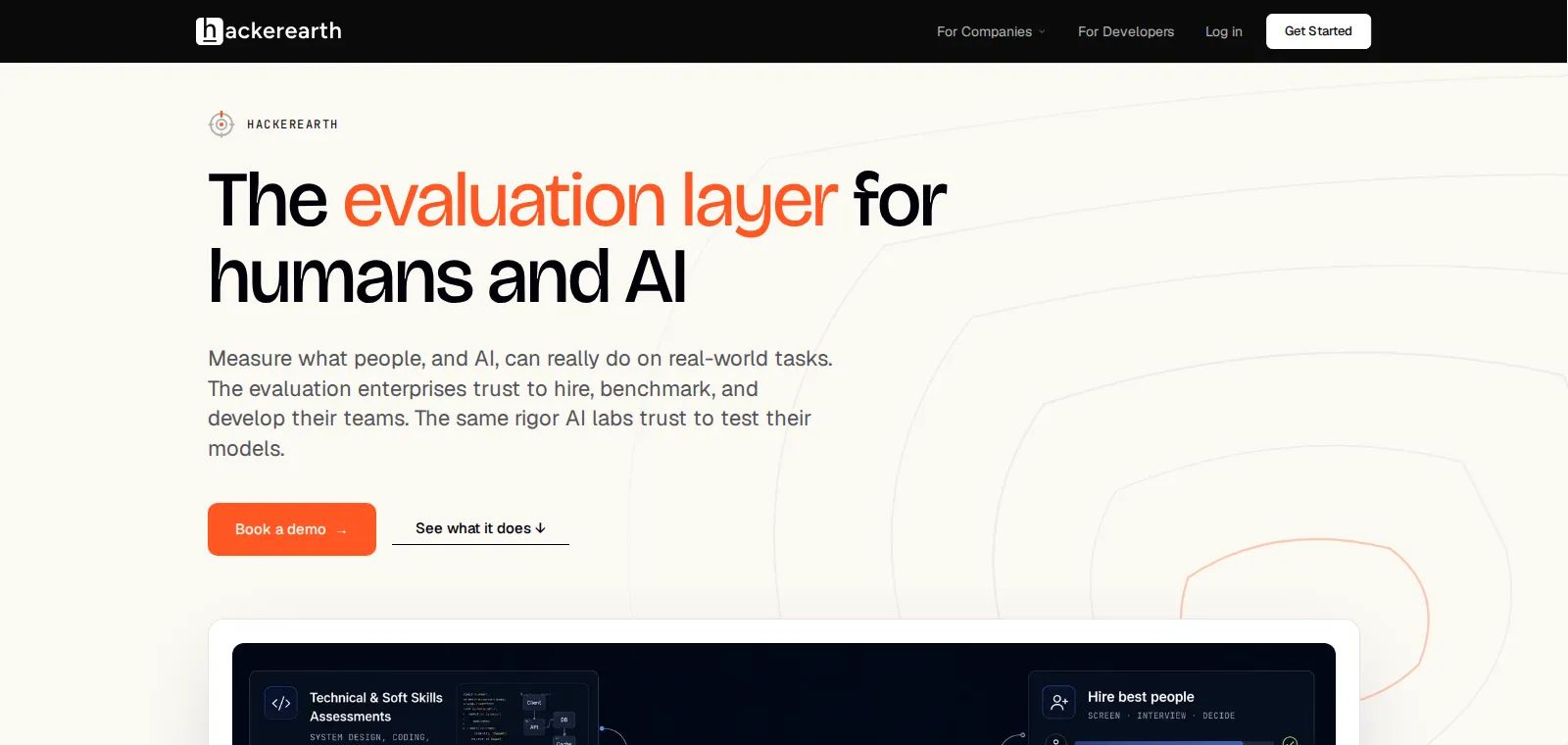
- Based in: Sunnyvale, California, with offices in Bengaluru, Chicago and New York
- Features: team creation, idea shortlisting, automatic scoring of every submission, plagiarism detection
- Managed service: a process manager, design support, promotion and evaluation support, for virtual, in-person or hybrid events
- Security: SOC 2 Type II, ISO 27001, ISO 27017 and GDPR, with a 99.9% uptime SLA
- Speed: HackerEarth says most hackathons go live within two weeks of finalizing the statement of work
HackerEarth is built around evaluation and hiring, and its pages describe no participant build environments. It gives a rough price range (under $5,000 for an internal hackathon, six figures for a large external one), which is more than most vendors publish.
4. AngelHack
Best for: developer-relations teams that want an agency to design, promote and run a public hackathon
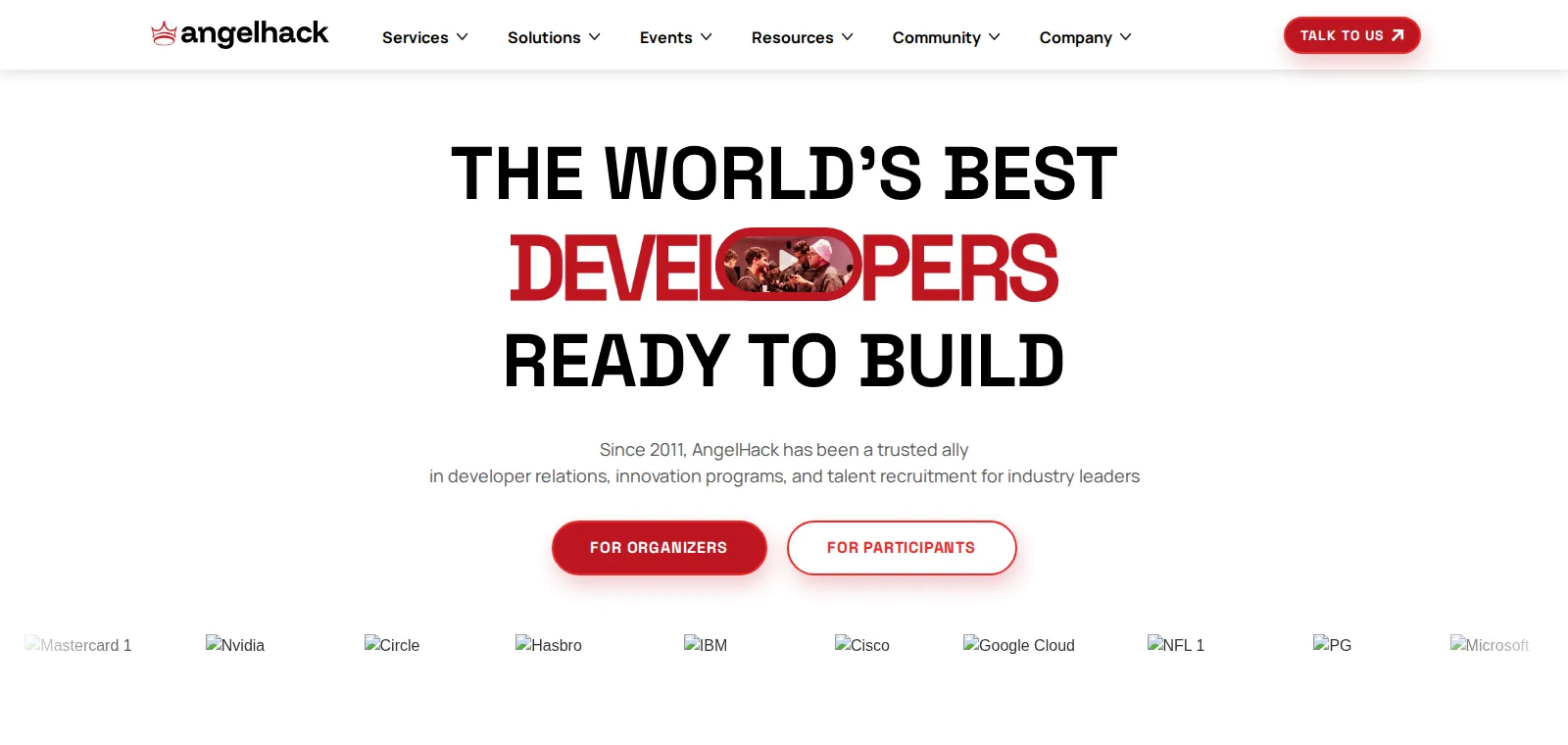
- Based in: Singapore
- Features: registration, team formation, submissions, rubric-based judging, prize payouts and analytics on its StackUp platform
- Managed service: program design, promotion, workshops, mentoring and office hours
- Community: StackUp, a developer community, now runs under the AngelHack umbrella
- Event length: AngelHack puts virtual hackathons at one to four weeks long, with 8 to 12 weeks to organize
AngelHack works on custom pricing and runs events for you, so it suits teams that want to hand the event off. Its pages describe no participant cloud environments.
5. TAIKAI
Best for: European organizations and Web3 projects that want a self-service hackathon platform with voting
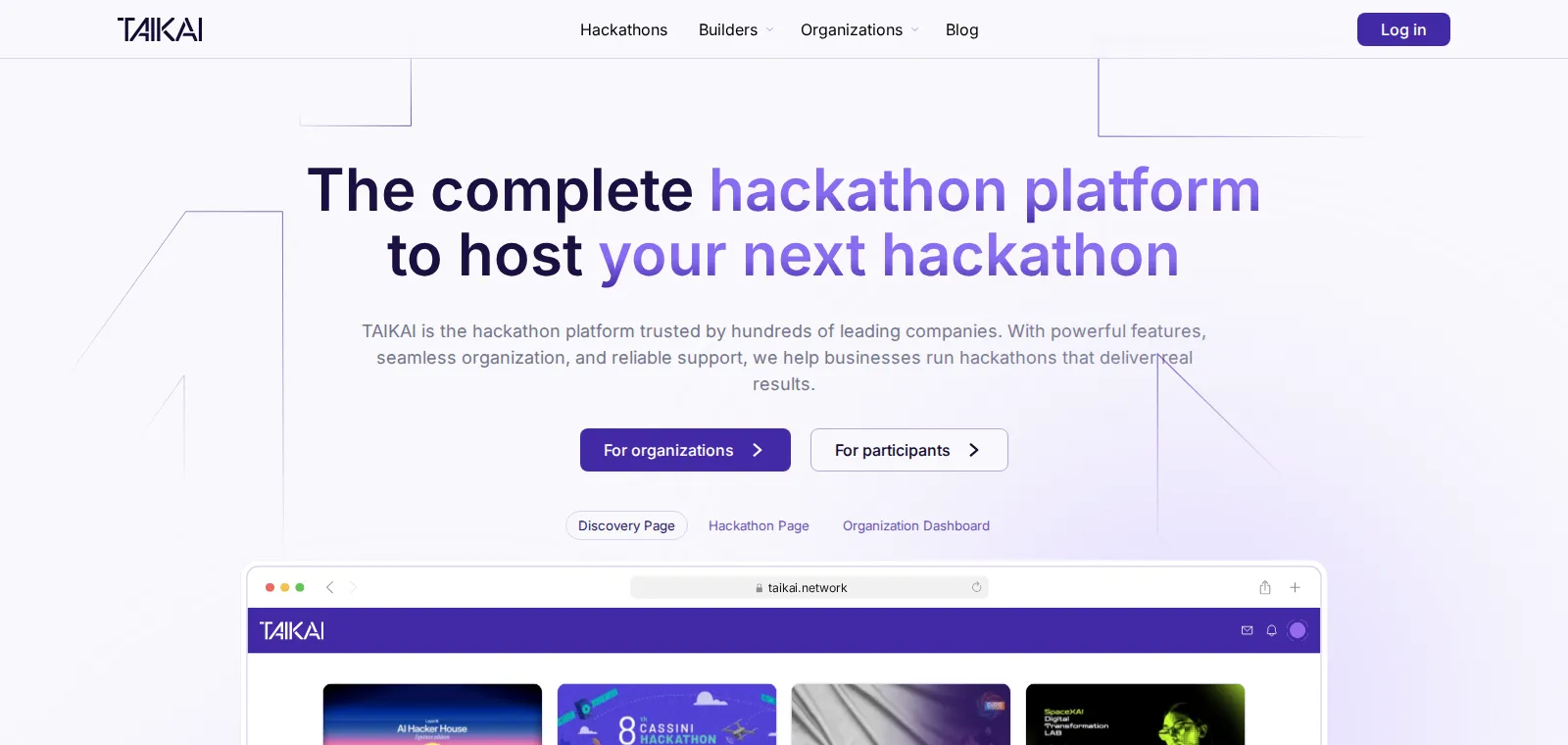
- Based in: Porto, Portugal
- Features: registration, team matchmaking, event timeline, internal chat, a submission dashboard and a voting system
- Integrations: Slack, Microsoft Teams and Discord for live chat, plus livestreaming and a native MCP connector
- Compliance: GDPR, with its platform audited by Hacken
TAIKAI’s pricing page has been taken down, so you’ll need to ask for a quote. Its blockchain roots (Ethereum sign-in, token-based voting) suit Web3 events more than a corporate cloud hackathon, and it offers no participant build environments.
6. Eventornado
Best for: mid-size corporate and public-sector hackathons in Europe that need a simple, GDPR-minded event tool
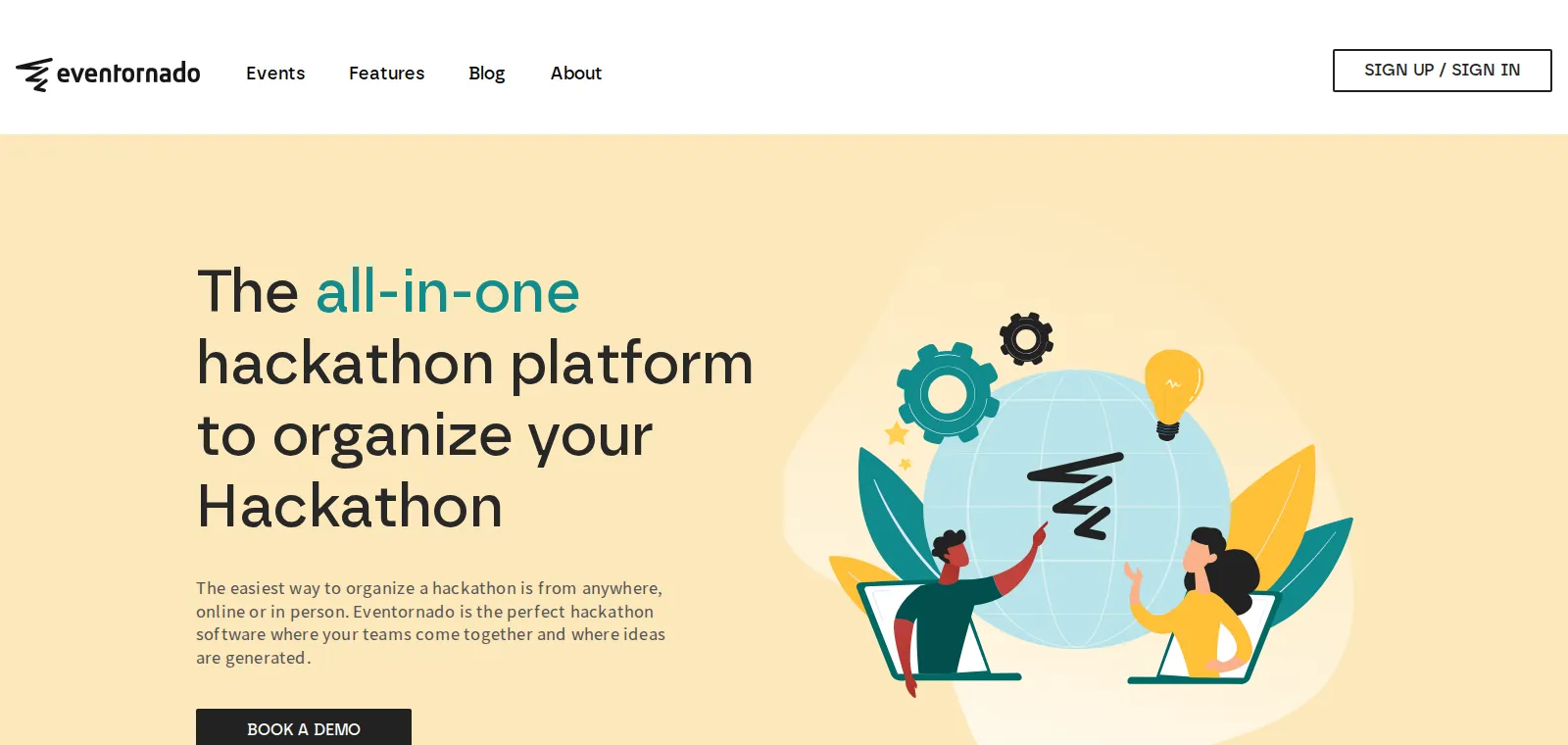
- Based in: Tallinn, Estonia
- Features: registration, team formation, mentor involvement, an in-built team chat and a public event page
- Judging: centralized voting with a full audit trail
- Compliance: data handling set out under GDPR
Eventornado manages ideas, teams and votes. It has no technical build or code-evaluation layer, and its pricing is available only through a demo.
7. BeMyApp
Best for: enterprises that want an agency to run hackathons and developer programs from recruitment to incubation
- Based in: San Francisco and Paris, with offices in Boise, Austin, London and Munich
- Features: registration and onboarding, project submissions, mentoring and judging, analytics and reporting
- White label: events run under your brand
- Hackathon.com: BeMyApp lists Hackathon.com as part of its group
BeMyApp is an agency, and it offers no self-serve plan. It doesn’t publish prices or provide participant cloud environments.
8. Agorize
Best for: corporate open-innovation challenges aimed at students, startups and employees
- Based in: Paris, France
- Features: a platform builder for the challenge site and application form, mentors through chat and webinars, central grading and commenting on submissions, and real-time KPI dashboards
- White label: branded challenge platforms
- Security: ISO 27001 and ISO 27701 certified
- Ownership: Agorize is now part of Bloomflow, an innovation management platform
Agorize suits idea and business challenges more than code-heavy hackathons. It publishes no prices, and its own pages give conflicting figures for the size of its community.
9. Heropa
Best for: teams that already have an event platform and need isolated lab environments for participants
- Based in: Sydney, Australia
- Environments: identical, isolated virtual machines for each participant, labs in the region closest to participants, and isolated, shared or hub-and-spoke network setups
- Cost control: schedules and quotas that shut down and delete lab environments
- Support: labs launched before the event starts, integrated chat, audio and video, and remote over-the-shoulder help
- Pricing model: billed on monthly cloud consumption, with no setup fees
Heropa is the only platform here besides CloudLabs that gives participants build environments. Its hackathon page lists no registration, team formation, submission or judging features, so you’d run it next to a separate event platform.
10. lablab.ai
Best for: AI companies that want to sponsor public AI hackathons and reach builders

- Based in: NativelyAI Inc., a Delaware corporation
- Format: online and in-person AI hackathons, often month-long, with solo or team entries
- Features: mentors on request, a leaderboard and pitch sessions streamed on Twitch
- For participants: all events are free to attend, and sponsors often provide compute and API credits
lablab.ai runs a sponsor-funded community. It doesn’t license a platform for private internal hackathons, and any compute comes from each event’s sponsor.
Hackathon hosting platforms compared
| Platform | Type | Participant cloud environments | Published pricing | Best for |
|---|---|---|---|---|
| CloudLabs | Managed hackathons with built-in cloud labs | Yes, per team or participant, on Azure, AWS or Google Cloud | Quoted per event | Hackathons where participants build on cloud |
| Devpost | Hackathon platform and community | No | Free for student hackathons; others quoted | Public hackathons that need reach |
| HackerEarth | Managed hackathons with automated evaluation | No | Range: under $5,000 internal, six figures external | Hiring hackathons |
| AngelHack | Hackathon agency on StackUp | No | Custom | Public developer-relations programs |
| TAIKAI | Self-service hackathon platform | No | Not published | European and Web3 events |
| Eventornado | Self-service hackathon platform | No | Not published | Mid-size European events |
| BeMyApp | Hackathon agency | No | Not published | Fully managed enterprise programs |
| Agorize | Open-innovation challenge platform | No | Not published | Idea and business challenges |
| Heropa | Lab environment platform | Yes, isolated VMs | Monthly consumption, no setup fee | Adding environments to another event platform |
| lablab.ai | Sponsor-funded AI hackathon community | No (sponsor credits) | Free for participants | Sponsoring public AI hackathons |
How to host a virtual hackathon
To host a hackathon online, you need about 8 to 12 weeks, which is the range AngelHack gives for organizing one. Use the plan below, and start the environment work early if participants will build on cloud.
| When | What to do |
|---|---|
| Weeks 12–10 | Set one goal (adoption, hiring, innovation or skills). Pick the format: one to two days for a challenge, one week to a month for open innovation. Choose the platform. |
| Weeks 9–7 | Write the challenge statements and judging criteria. Decide what participants build on: a cloud subscription, VMs, API keys or a sandbox of your product. Open registration. |
| Weeks 6–4 | Promote the event. Recruit mentors and judges. Build the participant environment and test it with a small group. |
| Weeks 3–1 | Confirm cloud quotas in each region. Load-test environments at full headcount. Set spending limits, idle shutdown and a deletion date. Run a dry run with mentors. |
| Event | Open with a briefing. Keep mentor office hours. Watch environment health and cloud spend every day. |
| Week after | Judge submissions. Announce winners. Delete environments. Send stakeholders a report on attendance, lab use, completion and cost. |
A few things decide whether the plan works:
- Pick one goal. A hackathon that tries to drive adoption, hire and innovate at once gives judges no clear criteria.
- Estimate attendance early. Cloud environments are built and paid for per participant, so the headcount sets your quota requests and budget. Devpost reports 5% to 33% of registrants submitting a project, so plan environments for registrants and judging for submitters.
- Set the environment up before day one. Participants who spend their first morning fixing access lose momentum. Pre-provision and test every environment, and have support on call from the opening briefing.
- Cap spending. Give each team or participant a credit limit, shut down idle VMs and set a deletion date. Without these, a 30-day event keeps billing after the winners are announced.
- Give teams a place to work together. Use team channels in Microsoft Teams, Slack or Discord, and schedule mentor office hours so stuck teams can get help.
- Judge what was built. Ask for a working deployment or a validated lab result alongside the demo video, and keep environments running until judging ends.
How much does it cost to host a hackathon?
A hackathon costs anything from a few thousand dollars to more than $200,000, depending on size, prizes and how much of the work you hand off. The vendors that publish figures give these ranges:
- HackerEarth: under $5,000 for an internal hackathon, and six figures for a large external one
- AngelHack: $5,000 to $15,000 for lean events, and $50,000 to $200,000 or more for enterprise events with large prize pools and full production
- Eventornado: €2,000 to €80,000, and more than €100,000 for very complex events
Eventornado’s cost breakdown lists venue, catering and prizes, and AngelHack ties its top range to prize pools and production. Neither counts the cloud resources participants build on. If your hackathon needs cloud environments, ask each vendor for two prices, one for the platform and one for cloud usage, and ask how they cap spending. The guide to virtual IT lab pricing shows how lab platforms charge for cloud usage.
FAQ
How long should a hackathon last?
A challenge-based hackathon runs one to two days. An open innovation hackathon, where teams build working solutions, runs one week to one month. AngelHack puts most virtual hackathons at one to four weeks. IBM’s 2025 agentic AI hackathon on CloudLabs ran 30 days.
How far ahead should you plan a hackathon?
Plan for 8 to 12 weeks, the range AngelHack gives. Managed services can go faster: HackerEarth says most of its hackathons go live within two weeks of a signed statement of work. If participants build on cloud, leave time to secure quotas and load-test environments before the event.
Can you host a hackathon for free?
Yes, in some cases. Devpost hosts student-run, student-only hackathons for free, and lablab.ai events are free for participants because sponsors pay for them. A corporate hackathon pays for the platform, prizes and any cloud resources participants use.
How do you judge a hackathon fairly?
Publish the criteria before the event, use the same scorecard for every judge, and score what teams built along with how they presented it. Platforms such as CloudLabs and HackerEarth add automated validation or scoring, so judges start from the same objective results.
What do participants need to build during a hackathon?
Participants need a working environment with the tools, cloud services and API access the challenge requires. For a cloud hackathon, that means a subscription or sandbox per team, with spending limits and access set up before day one. CloudLabs and Heropa provide these environments, while the other platforms here expect you to supply them.
Conclusion
For hackathons where participants build on Azure, AWS or Google Cloud, CloudLabs is the best hackathon hosting platform on this list.
It is the only platform here that runs the whole event (registration, teams, mentoring, judging) and also provisions and controls the cloud environments participants build in. Its event record:
- IBM ran a 30-day hackathon on it with more than 450 participants in 225 teams from 25 countries, and came back for a third year.
- Capgemini ran more than 1,200 participants with zero environment failures and 4.5 out of 5 satisfaction.
- EY’s participants rated its three-day event 4.42 out of 5.
- Databricks served a 7,000-attendee summit after CloudLabs load-tested the environment a month ahead.
Across its customers, CloudLabs has provisioned more than 5 million labs.
If you need a large outside developer community to recruit participants, Devpost or AngelHack may suit you better, on their own or alongside CloudLabs. If you’re hiring, HackerEarth’s evaluation tools fit that goal. If your participants need to build on real cloud, start with CloudLabs.
See how CloudLabs runs hackathons.
For related reading, see how to host successful virtual tech events and the top 10 virtual lab platforms.
Related Blogs
 CloudLabsBest Partner Training LMS Platforms for 2026The best LMS platforms for partner enablement in 2026, ranked on hands-on product practice, per-partner portals and CRM fit: CloudLabs, Docebo, Skilljar, CYPHER and more.
 CloudLabsBest Cybersecurity Lab and Cyber Range Platforms for 2026The best cybersecurity lab and cyber range platforms for 2026, for SOC teams, colleges and security vendors: CloudLabs, Cyberbit, Immersive and more.